
Loading...
Loading...

Injectable Suspension
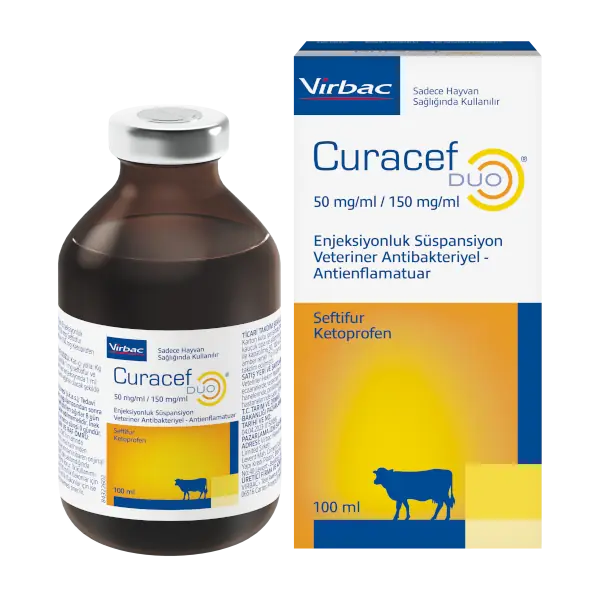
Only for veterinary use
Composition
Curacef Duo Injectable Suspension contains 51.5 mg of ceftiofur hydrochloride (equivalent to 50 mg of ceftiofur) and 150 mg of ketoprofen per 1 ml, and is a sterile suspension that is white to pinkish in color.
Pharmacological Properties
Pharmacodynamic Properties
Ceftiofur is a third-generation cephalosporin effective against many gram-positive and gram-negative bacteria. Like other beta-lactams, ceftiofur exerts its bactericidal effect by inhibiting bacterial cell wall synthesis.
Cell wall synthesis depends on enzymes called penicillin-binding proteins (PBPs). Bacteria can develop resistance to cephalosporins through four main mechanisms:
• Modification or acquisition of penicillin-binding proteins that have reduced affinity for beta-lactams.
• Altered permeability of the cell to beta-lactams.
• Production of beta-lactamases that break the beta-lactam ring of the molecule.
• Active efflux through membrane transport mechanisms.
Some beta-lactamases found in gram-negative enteric organisms may cause increased minimum inhibitory concentrations (MICs) for third- and fourth-generation cephalosporins, as well as penicillins, ampicillin, beta-lactam inhibitor combinations, and first- and second-generation cephalosporins.
Ceftiofur is effective in cattle against the following microorganisms that cause respiratory diseases: Pasteurella multocida and Mannheimia haemolytica (formerly Pasteurella haemolytica).
Ketoprofen is a derivative of phenylpropionic acid and belongs to the nonsteroidal anti-inflammatory drug (NSAID) group. Its mechanism of action is related to its ability to inhibit the synthesis of prostaglandins from precursors like arachidonic acid. Following endotoxin production, ketoprofen does not directly affect endotoxins, but it reduces prostaglandin production, which diminishes the effects of prostaglandins. Prostaglandins are part of complex processes involved in endotoxin shock development. As with other molecules in this therapeutic class, its primary pharmacological effects are anti-inflammatory, analgesic, and antipyretic.
Pharmacokinetic Properties
After administration, ceftiofur is rapidly metabolized to its major active metabolite, desfuroylceftiofur. Desfuroylceftiofur has antimicrobial activity against target bacteria comparable to ceftiofur. The active metabolite is reversibly bound to plasma proteins. Due to its transport via these proteins, the metabolite concentrates at the site of infection, continuing its action in the presence of necrotic tissue and tissue residues.
Ceftiofur is completely bioavailable following intramuscular administration.
After a single intramuscular dose of 1 mg ceftiofur (hydrochloride) per kg body weight in cattle, the maximum plasma concentration (Cmax) of ceftiofur and its metabolite desfuroylceftiofur reaches 6.11 ± 1.56 μg/ml within 5 hours (Tmax). The half-life (t½) for the plasma concentration of ceftiofur and desfuroylceftiofur is 19 hours. Elimination is primarily via urine (over 55%), with 31% of the dose found in feces.
Ketoprofen is completely bioavailable following intramuscular administration. After a single intramuscular dose of 3 mg ketoprofen per kg body weight in cattle, the maximum plasma concentration (Cmax) of ketoprofen reaches 5.55 ± 1.58 μg/ml within 4 hours (Tmax). The half-life (t½) of ketoprofen in plasma is 3.75 hours. Ketoprofen is highly protein-bound in cattle (97%). Elimination is primarily via urine (90% of the dose) in its metabolized form.
Indications / Uses
For the treatment of respiratory diseases (BRD) caused by Mannheimia haemolytica and Pasteurella multocida, and for reducing clinical signs associated with inflammation or fever.
Dosage and Administration
For intramuscular use.
Administer 1 mg of ceftiofur per kg body weight/day and 3 mg of ketoprofen per kg body weight/day, which corresponds to 1 ml of suspension per 50 kg body weight per injection.
The product should only be used if the disease is related to inflammation or fever.
The product may be applied for 1 to 5 consecutive days depending on the clinical response of the case. Since antibiotic treatment should last at least 3 to 5 days, once inflammation and fever have subsided, the veterinarian should switch to a treatment with only ceftiofur for a continuous 3 to 5-day antibiotic therapy. Only a small number of animals are expected to require a fourth or fifth injection with the combination product.
Shake the bottle vigorously for 20 seconds before use to homogenize the suspension.
The suspension may take longer to homogenize after being stored at low temperatures.
To ensure the correct dose, the body weight of the animals should be determined as precisely as possible to avoid underdosing.
The user should choose the most appropriate presentation based on the number of animals to be treated. Bottles of 50 ml and 100 ml should not be punctured more than 10 times, while 250 ml bottles should not be punctured more than 18 times. To avoid cap rupture, it is recommended to use an aspiration needle.
Avoid consecutive injections in the same area. Do not apply more than 16 ml to a single injection site.
Withdrawal Period
• For cattle, do not send for slaughter within 8 days after the last treatment.
• For milk in cows, the withdrawal period is 0 days.